What is Ethocology

What is Ethocology

Ethocology is a translational design discipline that applies insights from ethology, ecology, and neurobiology to the environments we create—so that regulation, learning, and contribution can develop steadily and endure over time.

Alignment that releases survival energy for development.

For most of history, these environments shaped us slowly, physically, and coherently.

Today they change faster than our biology, our attention, and our social structures can adapt.

The result is not failure of individuals.

It is a design mismatch.

Why it Matters


If environments shape behavior, cognition, & culture…

What happens when those environments are no longer designed around human limits?

What happens when systems are optimized for scale, speed, and output, without accounting for the people inside them?

Ethocology = { Ethology behavior as an evolved system + Ecology organism–environment relationships } = Environment Design aligned with biological reality

Ethocology is a translational design discipline that applies insights from ethology, ecology, and neurobiology to the environments humans create — with the aim of restoring fit between evolved regulatory systems and the conditions of modern life.

The Trajectory

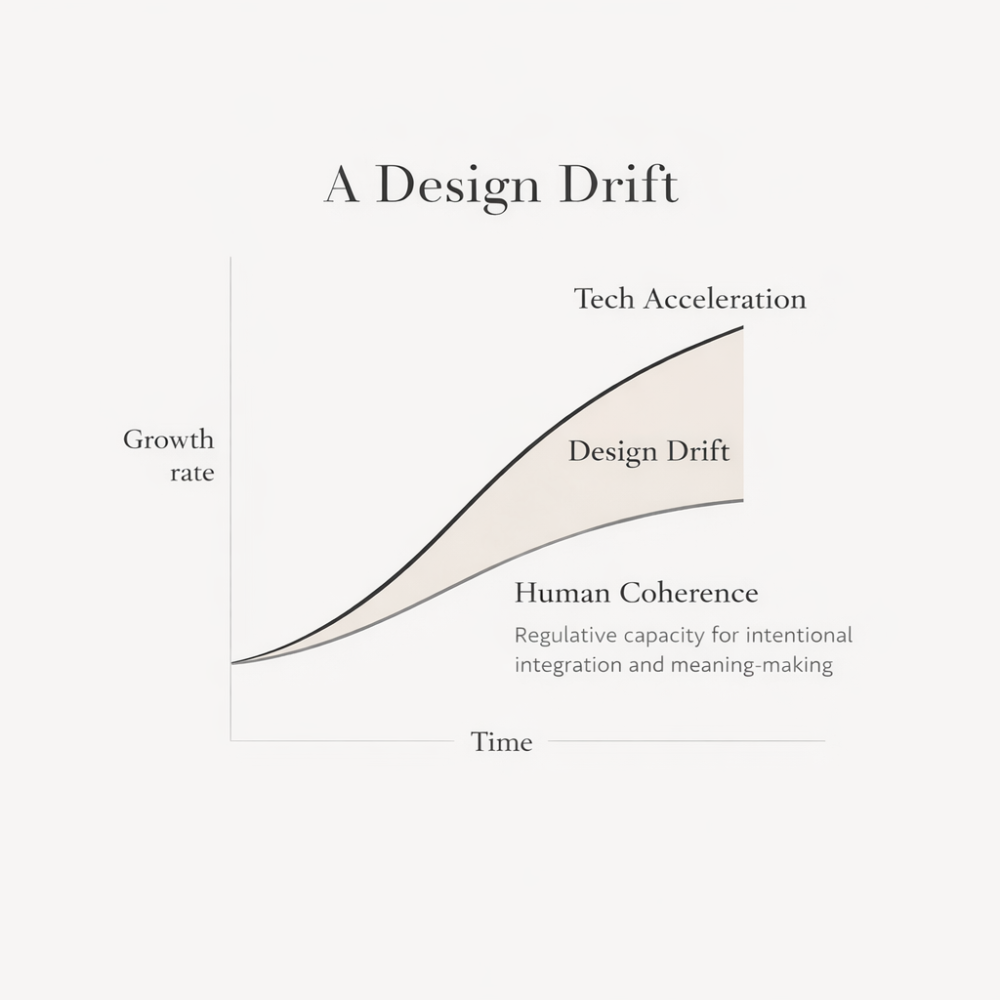
A Design Drift

Over the past century, technological environments expanded rapidly, scaling for adoption rather than sustained human integration.

Many legacy institutional systems followed the same trajectory, optimized for throughput and standardization rather than human coherence.

Tools expanded.
Systems scaled.
Information multiplied.

But the environments carrying this change were rarely designed to preserve regulation, continuity, or meaning at the human scale.

These dynamics are explored biologically in Dopamine Ethocology, which examines how environmental design influences regulation and continuity over time.

The strain many experience today is not personal inadequacy.

It is a loss of alignment.

Ethocology diagram showing design drift as technology accelerates faster than human coherence over time.

The Design Question

As technological environments expanded, the central problem began to change.
The challenge was no longer how to build more powerful systems, but how to ensure those systems remained compatible with the capacities of the people using them.

Ethocology studies how environments can be structured to support regulation, continuity, and sustained meaningful human performance at scale.

Environments that work with human nature, not against it.

Ethocology symbol representing nested relationships between organism, behavior, and environment.

What Ethocology Is

Ethocology is the study and design of environments where alignment with human nature becomes the path of least resistance.

It brings together insights from ecology, neuroscience, design, systems theory, and lived human experience to understand how conditions shape behavior more powerfully than intention alone.

Rather than asking individuals to endlessly adapt to systems that move faster than they can integrate, Ethocology examines how environments themselves can carry more of the regulatory load.

The overall patterns observed in Dopamine Ethocology reflect this relationship between environment, regulation, and sustained participation.
(A deeper exploration of this connection is developed separately.)

Ethocology asks:

What would it mean to build systems that fit the person?

Not by simplifying the human, but by structuring environments that support regulation, continuity, and sustained meaningful participation over time.

The Node

How Coherence Scales

Complex systems do not grow through continuous force. They grow through points of reception, processing, and transmission.

A node is where change is integrated before it moves forward.

Scaling occurs not by speeding everything up, but by preserving coherence at each node.

For human nodes, coherence depends on specific conditions:

Regulation supported by environments that reduce chronic overload
(rhythms, signals, and spaces that allow recovery as well as action)

Access to accurate information shaped by transparent, non-distorting systems
(signals that clarify reality rather than compete for attention)

Bonds reinforced by environments that enable stable relationships over time
(structures that allow trust, reciprocity, and shared meaning to accumulate)

Trajectories made visible through conditions that allow effort to resolve into direction
(feedback, continuity, and pathways that connect action to outcome)

Human beings are not external to these structures.

We participate in it.

We are regulatory nodes within the environments we inhabit.

Parallel expressions:

Biological tissue
healing, adaptation, and recovery

Branching ecosystems
relationships, families, and communities

Hydrological basins
attention, rest, and renewal cycles

Neural organization
learning and memory formation

Infrastructure networks
collaboration and shared work

Knowledge systems
culture, education, and transmitted understanding


When environments ignore the limits of the human node, systems may grow, but individuals experience fragmentation, overload, and loss of agency.

Ethocology studies how to design environments that scale without destabilizing the nodes that sustain them.

Regulation determines how this signal is shaped.

Environments that provide stability, rhythm, and trustworthy feedback allow orientation to accumulate.
Bonded relationships reinforce this by carrying effort forward across time.

Under these conditions, motivation does not spike.
It stabilizes.

Not all stimulation produces direction.
Rapid novelty and variable reward intensify attention, but without continuity the signal cannot organize behavior.

Human-centered design is not the amplification of motivation.
It is the structuring of conditions that allow experience to resolve into learning, action, and relationship.

Tonic environments make navigation possible.

Tonic Dopamine
Background regulation

Tonic dopamine reflects the nervous system’s sense of continuity. It builds gradually in environments that are stable, legible, and relational, allowing effort to accumulate into learning, trust, and sustained direction over time.
Tonic dopamine is what lets a person continue.

Phasic Dopamine
Event-based activation

Phasic dopamine responds to change. It rises in moments of novelty, reward, or interruption, helping attention shift and orient to what is new, but it cannot organize behavior without an underlying field of stability.
Phasic dopamine is what lets a person shift.

Together

Healthy environments allow phasic activation to resolve into tonic structure — turning moments of stimulation into patterns the human system can actually live within.

Stable Environments Support Tonic Regulation

They create a steady sense of orientation, capacity, and progress.

Fragmented environments drive phasic cycling stimulation without integration.

Phasic initiates. Tonic sustains.

This is not discipline. It is design

Ethocological Environments

Human-centered environments are not softer environments.
They are environments designed to support a stable baseline of regulation so experience can organize into direction.

They help trajectory by amplifying signal, reducing noise, and preserving the conditions in which agency can function over time.

When stability, rhythm, and trustworthy feedback are present, effort resolves into learning, cooperation, creativity, and responsibility rather than fragmentation.

Ethocology studies how to design these conditions intentionally.

Recurring Patterns Across Scales

From childhood exploration to career decisions to relationships, humans are continuously processing experience.
Success, failure, friction, and ease are not opposites — they are information.

Natural systems already operate this way.
Fractals expand, test, and stabilize. The golden ratio allows growth to widen while preserving coherence. Ecosystems and markets circulate signals, retaining what works and releasing what does not.

These are not aesthetic coincidences.
They are structural methods for learning through iteration.

In human development, what we call failure is simply unresolved data. Each experience forms a node that must be processed, integrated, and brought to closure before energy can move forward. When closure occurs, the signal clarifies. Direction becomes possible.

Ethocological environments are designed to support this process — to receive experience, reduce noise, and allow both positive and negative feedback to resolve into understanding rather than accumulation.

Trajectory emerges not from constant success, but from completed loops.

Growth is the result of many closures, not endless input.

Spiral architectural form guiding movement through continuous spatial transition.

Ethocology is not about optimizing people.

It is about designing conditions where human capacitiesattention, care, imagination, cooperation — can function as they evolved to.

The goal is not resistance to progress.

It is progress that remains livable.

The Next Decades

The technological curve continues in both cases.
The difference is whether environments remain compatible with the humans inside them.

Human-Centered Design Adopted Human Factors Ignored
Years one through ten
Workflows prioritize completion and pacing. Burnout begins to decline as friction is designed out. Acceleration continues without translation. Burnout becomes ambient as people absorb design debt.
Technology reduces reorientation and noise, supporting continuity across the day. Technology increases inputs and urgency, fragmenting attention into short cycles.
AI is used to protect agency: clearer handoffs, fewer unnecessary decisions, more stable judgment. AI amplifies dependency: more micro-decisions, higher volume, weaker comprehension of the whole.
Organizations shift from heroics to quiet execution. Quality improves through coherence, not pressure. Organizations normalize churn. Output looks high, but coherence drops and rework compounds.
Years eleven through twenty
Human-centered defaults become infrastructure: interruption budgets, legible feedback, and stable pacing. Fragmentation becomes infrastructure: constant response expectations and always-on context switching.
Education aligns with attention development. Students gain continuity capacity, not just test performance. Education optimizes for engagement loops. Students lose deep focus and rely on stimulation to function.
Markets reward durability and trust. Low-friction coordination becomes a competitive advantage. Markets reward short-horizon extraction. Volatility is normalized, and costs are pushed into households and health.
Social environments support bonding conditions: predictable time, less noise, more co-regulation. Social environments reward stimulation: connection persists, but continuity thins and trust erodes.
Years twenty-one through thirty
Civic systems become more legible: feedback loops improve and long-horizon planning returns. Civic systems become more performative: short-cycle optics dominate while lived problems remain unresolved.
Public environments protect trajectory sovereignty: fewer coercive cues, clearer boundaries, more internal thought-space. Public environments intensify attention capture: constant redirection collapses internal trajectories before they form.
Innovation compounds through preserved continuity: deep work, careful craft, and stable collaboration scale. Innovation becomes brittle: speed increases, but coherence declines and failure rates rise.
Health improves as regulation becomes a design baseline: lower chronic stress, better recovery, stronger social buffering. Health degrades under ambient stress: individuals are blamed while environmental causation is ignored.
Years thirty-one through forty
Society sustains a livable acceleration curve: progress remains compatible with meaning, responsibility, and depth. Society sustains an unlivable acceleration curve: humans adapt toward systems, trading coherence for constant adjustment.
Culture becomes meaning-capable again: long-form attention and slow-signal communication are supported. Culture becomes novelty-dominant: stimulation displaces meaning and shared narratives fracture.
Institutions mature toward tonic governance: coalition capacity, stable policy, and developmental pathways. Institutions remain phasic-selected: reactive cycles dominate and polarization persists as a structural outcome.
The human node remains intact: agency is usable, continuity holds, and growth becomes sustainable. The human node erodes: agency becomes cosmetic and life is lived in permanent compensatory mode.

This is not a prediction. It is a design sensitivity map:
environmental choices compound into long-run direction.

Frequently Asked Questions

What is Ethocology?

Ethocology is an emerging approach within environment design and behavioral science that examines how built, digital, and social environments influence human regulation, attention, learning, and long-term functioning. It integrates insights from ethology, ecology, and neurobiology to design conditions that align with how humans actually adapt and operate over time.

How is Ethocology different from human-centered design?

Human-centered design primarily focuses on usability, experience, and problem-solving for specific products or services. Ethocology is an approach within biologically informed design that looks more broadly at how entire environments shape behavior, cognition, and wellbeing over time. Rather than optimizing interactions, it seeks to align systems with human physiological and behavioral limits.

Why do modern environments feel overwhelming?

Research in environmental psychology and evolutionary mismatch suggests that many contemporary systems are optimized for speed, scale, and output rather than human cognitive and biological capacities. Ethocology describes this as a design mismatch—environments changing faster than our nervous systems can adapt, leading to chronic stress, distraction, and reduced ability to sustain attention or meaning.

Is Ethocology the same as behavioral ecology?

No. Behavioral ecology is a scientific field that studies how animal and human behaviors evolve in response to ecological pressures. Ethocology is an applied design approach that uses insights from behavioral ecology, neuroscience, and human-factors research to intentionally shape modern environments so they better support regulation, learning, and cooperation.

What kinds of environments does Ethocology apply to?

Ethocology can be applied to workplaces, schools, cities, digital platforms, and domestic spaces—any setting where environmental conditions influence human behavior and wellbeing. It is especially relevant to technology design, architecture, and organizational systems where rapid change can conflict with biological rhythms and attention limits.

What problem is Ethocology trying to solve?

Ethocology addresses the growing gap between human biological evolution and the environments we now inhabit. Many modern systems unintentionally push people into reactive, short-term modes of behavior. By redesigning environments to support regulation and continuity, Ethocology aims to enable sustained learning, creativity, and social stability rather than constant adaptation fatigue.

Is Ethocology a scientific field or a design philosophy?

Ethocology is best understood as a translational approach between science and design. It draws from established research in ethology, ecology, neuroscience, and human factors, and applies that knowledge to the intentional design of environments that support long-term human functioning.

Designing for Continuity

Human systems do not fail from lack of intelligence or effort.
They fail when environments fragment experience faster than it can be integrated.

Ethocology studies how to build conditions that allow signal to accumulate into understanding, and understanding into direction.

Not by accelerating input.
But by allowing experience to resolve.

Coherence is not imposed.
It is permitted.

Ethocology — Built for humans first. Everything else flows.”